

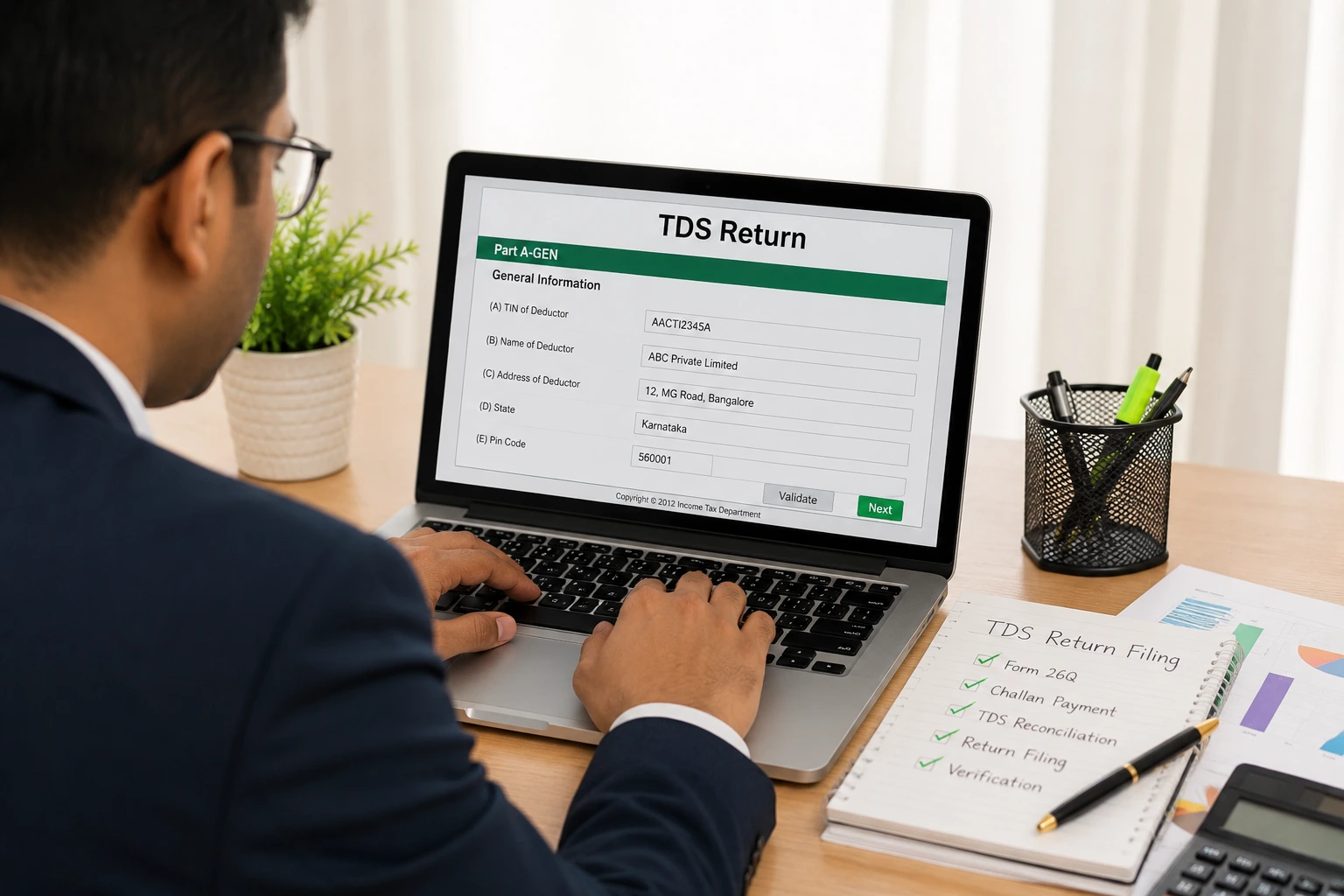
Tax Deducted at Source (TDS) is one of the most critical compliance obligations for businesses and individuals in India. Whether you are a salaried employee, a business owner, or a company making payments to vendors, understanding how to file TDS returns correctly can save you from hefty penalties, interest charges, and legal notices from the Income Tax Department.
This guide walks you through everything you need to know — from understanding TDS basics to filing returns step by step — so you stay compliant and penalty-free throughout the financial year.
What is TDS and Why Does It Matter?
TDS is a mechanism by which the person making certain payments (the ‘deductor’) deducts a percentage of tax at the source before making the payment to the recipient (the ‘deductee’). This deducted tax is then deposited with the government on behalf of the deductee.
TDS applies to a wide range of payments, including:
- TDS on Salary (Section 393 )
- TDS on Interest on Securities and TDS on Other Interest (other than securities) (Sections 396 & 397 )
- TDS on Rent (Section 404 )
- TDS on Professional / Technical Fees (Section 406 )
- TDS on Payments to Contractors(Section 401)
- TDS on Commission / Brokerage (Section 403 )
Non-compliance with TDS rules — including late deduction, late deposit, or incorrect return filing — attracts penalties, interest, and in serious cases, prosecution.
Key TDS Return Forms You Must Know
Choosing the right TDS return form is the first step toward correct filing. Here is a quick reference:
Form 138 – TDS on salary payments (to be filed by employers)
Form 140 – TDS on all payments other than salary (contractors, rent, professional fees, etc.)
Form 144 – TDS on payments made to non-residents or foreign companies
Form 143 – TCS (Tax Collected at Source) return.
Filing the wrong form is a common mistake and can lead to mismatches in Form 26AS, causing issues for deductees when they file their own income tax returns.
TDS Return Filing Due Dates — Quarter by Quarter
TDS returns are filed quarterly. Missing these due dates triggers penalties under Section 234E (Rs. 200 per day of delay) and Section 271H (up to Rs. 1 lakh).
Q1 (April to June): 31st July
Q2 (July to September): 31st October
Q3 (October to December): 31st January
Q4 (January to March): 31st May (for Form 24Q) / 31st May (for Form 26Q)
In addition to quarterly filing, TDS deducted must be deposited to the government by the 7th of the following month (with an exception for March — the deadline is 30th April).
Step-by-Step: How to File TDS Returns Correctly
Follow these steps carefully to ensure error-free TDS return filing:
- Obtain a Valid TAN (Tax Deduction Account Number) — Every deductor must have a TAN issued by the Income Tax Department. Quote this on all TDS-related documents and challans.
- Deduct TDS at the Correct Rate — Different sections prescribe different rates. Always verify the applicable rate and ensure you deduct accordingly. Using an outdated rate is one of the most common errors.
- Deposit Deducted TDS on Time — Use Challan ITNS 281 to deposit TDS with authorized banks or through the NSDL/TIN portal online. Keep the BSR code and challan serial number — you’ll need these during return filing.
- Collect PAN Details of Deductees — Incorrect or missing PAN data leads to higher TDS deduction (20%) and mismatches in the deductee’s Form 26AS. Always verify PAN before filing.
- Prepare TDS Return Data in RPU Software — Download the Return Preparation Utility (RPU) from the NSDL TIN portal. Enter challan details, deductee records, and validate the file using the File Validation Utility (FVU).
- Upload the Return — Log in to the TRACES/TIN-NSDL portal, select the appropriate form and quarter, and upload the validated FVU file. You’ll receive an acknowledgment (token number) upon successful submission.
- Issue TDS Certificates — After filing, generate and issue TDS certificates to deductees: Form 16 (for salary) and Form 16A (for non-salary payments), within the prescribed deadlines.
Common Mistakes That Lead to TDS Penalties
Even experienced finance teams make these errors. Being aware of them can help you avoid unnecessary penalties:
- Wrong PAN of deductee: Leads to mismatches and higher TDS deduction. Always verify PAN at the time of payment.
- Incorrect challan details: BSR code, challan date, or serial number errors cause mismatches that are difficult to correct later.
- Applying incorrect TDS rates: Budget changes often revise TDS rates. Always check the current applicable rate for each section.
- Late or non-deposit of TDS: Attracts interest at 1.5% per month from the date of deduction to the date of payment.
- Not filing for nil transactions: If TDS was deducted in a quarter, filing is mandatory even if the amount is small.
- Missing lower deduction certificate: If a deductee has Form 121 Declaration for non-deduction/Lower Deduction of TDS.
Penalties for TDS Non-Compliance: What You Risk
Understanding the penalty structure helps businesses prioritize compliance:
Section 398(3) Interest on failure to deduct or deposit TDS:
- Late deduction: 1% per month from the date tax was deductible to the date it was actually deducted
- Late deposit: 1.5% per month from the date of deduction to the date of deposit
Section 427 — Fee for default in furnishing TDS/TCS statements:
- 200 per day for each day of delay, subject to a maximum of the TDS amount
Section 467—Penalty for failure to file TDS/TCS returns or furnishing incorrect information:
- 10,000 to Rs. 1,00,000 for filing incorrect TDS returns, including wrong PAN or challan details
Section 478— Prosecution for failure to pay TDS to the credit of Central Government:
- In cases of willful failure to deposit TDS, rigorous imprisonment of 3 months to 7 years plus fine
To avoid all of the above, working with a reliable TDS consultant in Pune ensures your deductions, deposits, and filings are always accurate and on time.
How to Rectify TDS Return Errors After Filing
If you discover errors post-filing, you can file a correction statement on the TRACES portal. Common corrections include:
- Updating wrong PAN of a deductee
- Correcting challan details (BSR code, serial number, date)
- Adding a deductee record that was missed in the original return
- Revising TDS amounts or rates
Correction returns should be filed promptly, as prolonged mismatches can affect the deductee’s tax credit and trigger notices from the department.
Why Businesses in Pune Trust Azalea Advisors for TDS Compliance
Managing TDS compliance in-house requires dedicated resources, up-to-date knowledge of tax law changes, and meticulous attention to detail. Many businesses in Pune — from startups to established SMEs — choose to outsource this function to experts.
Azalea Advisors provides end-to-end TDS compliance services Pune businesses can rely on, including:
- Monthly TDS calculation and deduction review
- Timely deposit of TDS challans
- TDS on salary payments (to be filed by employers) , TDS on all payments other than salary (contractors, rent, professional fees, etc.), TDS on payments made to non-residents or foreign companies (Forms 138, 140, 144)
- TRACES portal management and 26AS reconciliation
- Certificate issued by employer reflecting salary paid and TDS deducted Form 130 and Form 131 to Certificate issued for TDS deducted on non-salary payments
- Correction return filing for past errors
- Handling income tax notices related to TDS
Whether you are a startup just getting started or a growing company looking to streamline compliance, TDS return filing in Pune is one area where expert help pays for itself — saving you from penalties that can far exceed the cost of professional services.
Getting Your Business Compliance Right From Day One
TDS compliance is just one piece of the larger compliance puzzle. Businesses that get their legal and tax structure right from the beginning — starting with proper company registration in Pune — are better positioned to manage ongoing obligations like TDS, GST, and ROC compliance with ease.
If you are setting up a new business, getting the right foundation matters. A proper business structure — whether it’s a Private Limited Company, LLP, or OPC — determines your tax obligations, including TDS applicability and rates.
Frequently Asked Questions (FAQs)
Q1. Who is required to deduct TDS?
Any person (individual, HUF, company, or firm) making specified payments — such as salary, rent, professional fees, or contractor payments — above the prescribed threshold limits is required to deduct TDS.
Q2. What happens if TDS is deducted but not deposited on time?
Interest at 1.5% per month is charged from the date of deduction to the date of actual payment. Additionally, the deductor may face disallowance of the expense under Section 40(a)(ia) during income tax assessment.
Q3. Can TDS return filing be done after the due date?
Yes, but it attracts a late filing fee of Rs. 200 per day under Section 234E, capped at the TDS amount. Penalties under Section 271H may also apply if the delay exceeds one year.
Q4. Is TDS applicable on payments to freelancers?
Yes. Payments to freelancers and consultants exceeding Rs. 30,000 per transaction (or Rs. 1,00,000 in a financial year) are subject to TDS under Section 194J at 10%. If the freelancer provides a PAN, the regular rate applies; otherwise, 20% is deducted.
Q5. How do I check if TDS has been correctly credited to my account?
Log in to the Income Tax e-filing portal and view your Form 26AS or the Annual Information Statement (AIS). These documents show all TDS credits against your PAN. Mismatches should be raised with the deductor for correction.
Q6. Can a business outsource TDS compliance?
Absolutely. Many businesses work with professional company registration consultants in Pune and compliance firms like Azalea Advisors to manage their complete TDS lifecycle — from deduction to return filing — ensuring accuracy and timely compliance without burdening internal teams.
Q7. What is Form 26AS and why is it important?
Form 26AS is a consolidated tax credit statement that shows all TDS deducted on your income, advance tax paid, and self-assessment tax. It is a critical document during income tax return filing, as the tax department uses it to verify your claims.
Ready to File TDS Returns Without the Stress?
TDS compliance does not have to be complicated. With the right guidance, you can ensure your deductions are accurate, deposits are on time, and returns are filed without errors — every single quarter.
Azalea Advisors is a trusted financial advisory firm based in Pune with over a decade of experience helping startups, SMEs, and growing businesses stay compliant. From TDS return filing to payroll management and company formation, we handle the complexity so you can focus on growing your business.
Address : 604, Archway, Sopan Baug Rd, Balewadi, Pune, Maharashtra 411045
Call : 85540 12300
Get Direction