
Starting a business independently gives entrepreneurs greater control over decision-making, operations, and business strategy. However, choosing the right legal structure is important when you want to protect your personal assets while operating your business independently.
A One Person Company (OPC) is a corporate structure that allows a single individual to establish a company while benefiting from separate legal identity and limited liability protection. It can be suitable for entrepreneurs who want more formal business recognition than a traditional proprietorship.
This guide explains how to set up an OPC in India, including eligibility, documents, registration steps, benefits, compliance requirements, costs, and important considerations.
Search Intent Analysis
This article is intended for:
- Entrepreneurs starting a business independently
- Freelancers planning to formalize their operations
- Small business owners considering an OPC
- Individuals comparing OPC and sole proprietorship
- Entrepreneurs looking for professional incorporation assistance
The primary search intent is informational with a commercial component, helping readers understand the OPC setup process before deciding whether professional assistance is appropriate.
What Is a One Person Company?
A One Person Company is a company incorporated with a single member under the Companies Act, 2013.
Unlike a sole proprietorship, an OPC has a separate legal identity from its member. This means the company can enter contracts, own assets, maintain a bank account, and conduct business in its own name.
An OPC can therefore provide an entrepreneur with the independence of single ownership while introducing a formal corporate structure.
Who Can Set Up an OPC?
An OPC is designed for an individual who wants to operate a company independently.
The proposed member must satisfy the eligibility requirements prescribed under the Companies Act and applicable rules. The incorporation process also requires nomination of a nominee who can become the member of the company in certain circumstances, subject to the applicable legal provisions.
Before incorporation, entrepreneurs should evaluate their business model, expected turnover, growth plans, and future funding requirements.
OPC vs Sole Proprietorship
Both structures allow an individual to operate a business, but they are legally different.
A sole proprietorship does not create a separate legal entity from the owner, whereas an OPC has a separate corporate identity.
Entrepreneurs searching for Sole proprietorship registration in Pune may prefer a simpler setup for a small business, while an OPC may be more suitable for someone who wants a formal corporate structure and limited liability protection.
The best choice depends on the business’s risk profile, expected growth, compliance capacity, and long-term objectives
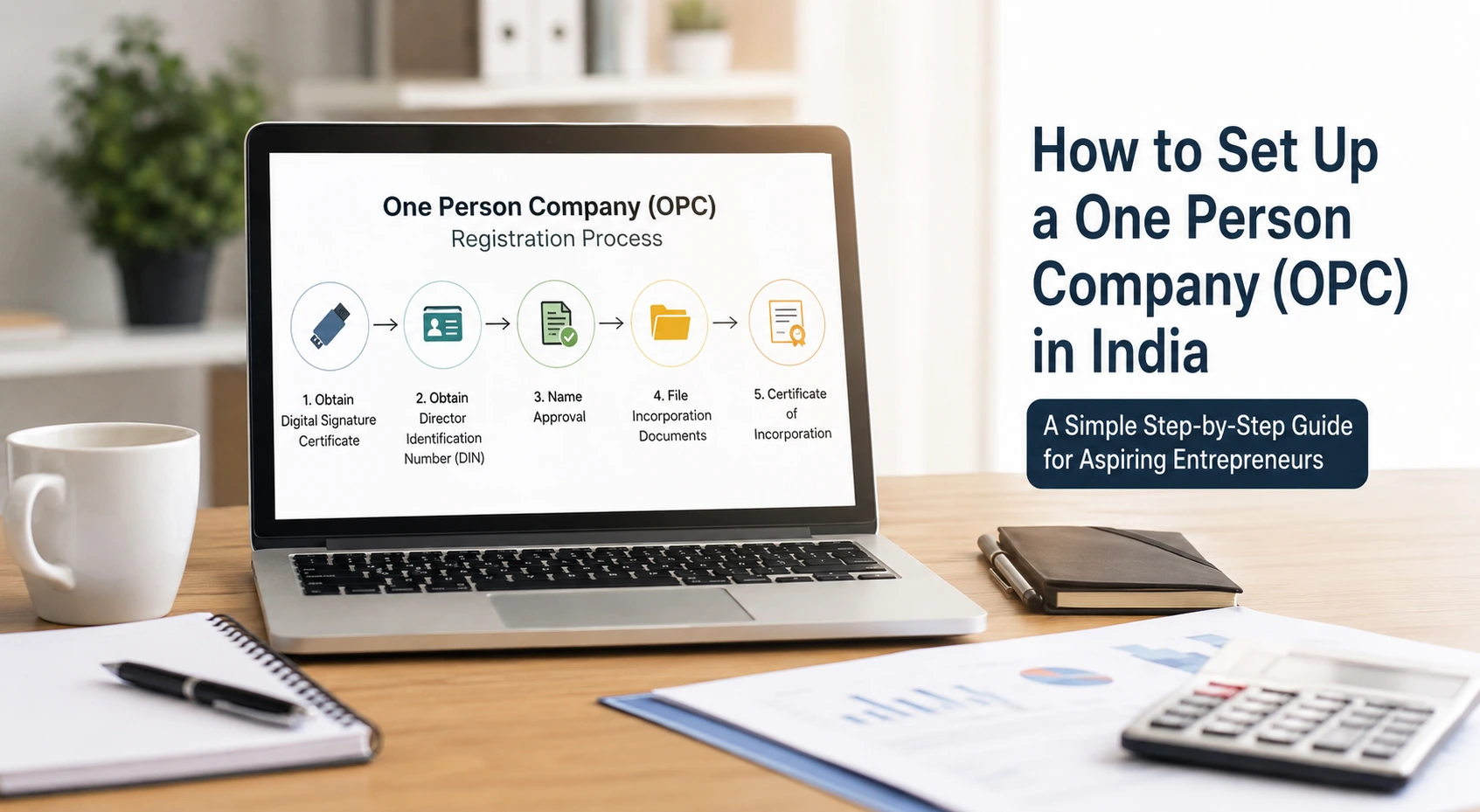
Step-by-Step Process to Set Up an OPC in India
Step 1: Decide Whether OPC Is Suitable
Before beginning the incorporation process, consider:
- Nature of business
- Expected turnover
- Business risks
- Funding plans
- Number of future owners
- Compliance requirements
- Long-term expansion plans
If you expect to bring in multiple shareholders or external investors soon, another company structure may be more appropriate.
Step 2: Obtain Digital Signature Certificate
The proposed director generally requires a Digital Signature Certificate (DSC) for digitally signing incorporation documents.
The applicant may need to provide identity and address documents, photographs, and other information required for issuing the certificate.
All information should be consistent across the documents.
Step 3: Obtain Director Identification Number
The proposed director requires a Director Identification Number (DIN), subject to the applicable incorporation procedure.
DIN provides a unique identification for an individual acting as a company director.
Step 4: Choose a Company Name
Selecting a suitable company name is an important stage.
The proposed name should:
- Be distinctive
- Comply with applicable naming rules
- Not conflict with an existing company or LLP
- Avoid trademark infringement
- Reflect the nature of the business where appropriate
Checking company and trademark availability before submitting the application can reduce the possibility of rejection.
Step 5: Prepare Required Documents
The applicant generally needs identity, address, and registered-office documentation.
Documents may include:
- PAN card
- Aadhaar or other accepted identity proof
- Address proof
- Passport-size photograph
- Registered office proof
- Utility bill
- Owner’s NOC, where applicable
- Nominee-related documents
Additional documents may be required depending on the circumstances.
Step 6: Submit the Incorporation Application
The OPC incorporation application is filed electronically through the Ministry of Corporate Affairs (MCA) system.
The application includes information relating to:
- Proposed company name
- Director
- Member
- Nominee
- Registered office
- Business activities
- Capital structure
The applicable MCA forms and filing requirements should be checked at the time of incorporation because procedures can be updated.
Step 7: Prepare MOA and AOA
The Memorandum of Association (MOA) and Articles of Association (AOA) form an important part of the company’s constitutional framework.
MOA
The MOA establishes the company’s objectives and scope of activities.
AOA
The AOA contains rules relating to the internal management and administration of the company.
These documents should be drafted carefully to reflect the company’s intended business activities and governance requirements.
Step 8: Nominee Declaration
An OPC requires nomination of another individual in accordance with the applicable legal provisions.
The nominee can become the member of the company in specified circumstances, subject to the relevant procedures.
The nominee’s consent and required documentation must be completed as part of the incorporation process.
Step 9: Receive the Certificate of Incorporation
After the MCA processes and approves the incorporation application, the company receives its Certificate of Incorporation.
This confirms that the OPC has been legally incorporated.
The company can then proceed with applicable post-incorporation requirements.
Documents Required for OPC Registration
A typical OPC incorporation process may require:
For the Director/Member
- PAN
- Identity proof
- Address proof
- Photograph
- Email address
- Mobile number
For the Registered Office
- Ownership proof or rent/lease documentation
- Utility bill
- No-objection certificate, where applicable
For the Nominee
- Identity and address proof
- Required consent/declaration
- Other documents prescribed under the applicable process
Document requirements can vary depending on individual circumstances.
Benefits of Setting Up an OPC
1. Single Ownership
An OPC allows an eligible individual to operate through a corporate structure without requiring multiple members.
2. Separate Legal Identity
The company has a legal identity distinct from its member.
3. Limited Liability
The member generally receives limited liability protection, subject to applicable law.
4. Better Business Credibility
A registered company can provide a formal structure when dealing with clients, suppliers, banks, and other stakeholders.
5. Business Continuity
Nominee provisions can support continuity of the business in circumstances specified by law.
OPC Compliance Requirements
Incorporation is only the beginning of the company’s legal responsibilities.
An OPC may need to comply with requirements relating to:
- Accounting records
- Income tax filing
- Annual MCA filings
- Financial statements
- Auditor-related requirements, where applicable
- GST compliance, where applicable
- Other statutory registrations
Compliance obligations depend on the company’s turnover, business activities, transactions, and applicable laws.
Maintaining accurate records from the beginning can make ongoing compliance easier.
OPC Registration in Pune
Entrepreneurs planning Company registration in Pune can compare OPC with other structures before deciding which model best fits their business.
Professional assistance can be useful for understanding documentation, MCA filing procedures, registered-office requirements, and post-incorporation obligations.
When choosing a service provider, consider experience, transparency, communication, documentation support, and whether post-registration assistance is available.
Why Professional Assistance Can Help
The incorporation process involves several legal and procedural requirements. Mistakes in documents, company names, declarations, or forms can lead to additional clarification or resubmission.
Experienced Company registration consultants in Pune can help entrepreneurs with:
- Structure selection
- Document verification
- Name selection
- Incorporation application
- MOA and AOA
- Nominee documentation
- Post-incorporation compliance guidance
Professional assistance can reduce administrative effort and help first-time entrepreneurs navigate the process more confidently.
Choosing the Right Business Registration Service
When comparing One person company registration in Pune, do not focus only on the advertised registration price.
Consider whether the provider offers:
- Transparent pricing
- Complete documentation support
- MCA filing assistance
- Professional consultation
- Post-registration support
- Clear communication
A reliable service provider should explain the process and applicable requirements before beginning the registration.
OPC vs LLP vs Private Limited Company
An entrepreneur should compare different structures before making a decision.
| Feature | OPC | LLP | Private Limited Company |
|---|---|---|---|
| Ownership | Single member | Two or more partners | Two or more members |
| Separate legal entity | Yes | Yes | Yes |
| Limited liability | Generally yes | Generally yes | Generally yes |
| External funding | Limited | Moderate | Generally more suitable |
| Management | Member/director | Partners | Directors |
| Ideal for | Solo entrepreneurs | Partnerships | Growth-oriented businesses |
Someone researching Best llp registration services in pune may be considering a partnership-oriented structure, while a solo entrepreneur may find OPC more aligned with single ownership.
Likewise, entrepreneurs expecting multiple shareholders or substantial equity funding may want to explore Private limited company registration in Pune instead.
Why Choose Azalea Advisors?
Azalea Advisors helps entrepreneurs understand business registration and compliance requirements.
Professional support can simplify the incorporation process by helping with documentation, application preparation, registration procedures, and applicable compliance requirements.
Before selecting a consultant, discuss your business model and future plans so the recommended structure aligns with your objectives.
Common Mistakes to Avoid
Choosing a Name Without Proper Verification
Check company and trademark availability before submitting the name.
Providing Inconsistent Documents
Ensure names, addresses, and other details match across documents.
Ignoring the Nominee Requirement
Nominee documentation is an important part of OPC incorporation.
Choosing OPC Without Considering Future Growth
If you expect multiple shareholders or significant external investment, evaluate alternative structures.
Neglecting Post-Incorporation Compliance
Regular accounting, tax, and statutory compliance should be planned after incorporation.
Frequently Asked Questions
1. Can one person start an OPC in India?
Yes. An eligible individual can establish an OPC subject to the requirements under applicable company law.
2. Is OPC a separate legal entity?
Yes. An OPC has a separate legal identity from its member.
3. Is a nominee required for an OPC?
Yes. Nomination is an important requirement under the applicable OPC framework.
4. Does an OPC provide limited liability?
Generally, yes. The member’s liability is ordinarily limited, subject to applicable law and specific circumstances.
5. Can an OPC have employees?
Yes. An OPC can employ people and conduct normal business operations.
6. Can an OPC be converted into another type of company?
An OPC may be converted into another company structure subject to applicable legal provisions and prescribed conditions.
7. Is GST mandatory for every OPC?
No. GST applicability depends on factors such as turnover, business activity, nature of supplies, and other statutory conditions.
8. Does an OPC have annual compliance requirements?
Yes. OPCs have applicable annual filing, accounting, tax, and corporate compliance requirements.
Conversion-Focused CTA
Choosing the right business structure is an important first step toward building a sustainable business.
If you are planning to establish a One Person Company, Azalea Advisors can help you understand the incorporation process, documentation, applicable requirements, and post-registration compliance.
Ready to set up your OPC?
Contact Azalea Advisors today to discuss your business requirements and get professional guidance for a smooth and organized incorporation process.