
Starting a business with a partner can be an exciting opportunity, but choosing the right legal structure is equally important. For entrepreneurs who want the flexibility of a partnership along with limited liability protection, a Limited Liability Partnership (LLP) can be an attractive option.
An LLP provides a separate legal identity to the business while allowing partners to manage operations according to the terms agreed upon in the LLP Agreement. It is particularly suitable for professional firms, consultants, service providers, startups, and businesses operated by two or more partners.
If you are planning to establish an LLP, this guide explains the registration process, eligibility requirements, documents, costs, timelines, compliance obligations, benefits, and common mistakes to avoid. Entrepreneurs exploring Company registration in Pune can also compare an LLP with other business structures before making a final decision.
What Is an LLP?
Why Choose an LLP for Your Business?
An LLP can be suitable for entrepreneurs who want flexibility without adopting all the structural requirements associated with a private limited company.
Major benefits include:
- Separate legal identity
- Limited liability protection
- Flexible management structure
- Perpetual succession
- No requirement for a minimum capital contribution
- Relatively flexible internal arrangements
- Suitable structure for professional and service-based businesses
The exact benefits depend on the nature and scale of the business, so entrepreneurs should evaluate their long-term objectives before choosing an entity.
Who Can Register an LLP?
An LLP generally requires at least two designated partners, with at least two individuals acting as designated partners. At least one designated partner must satisfy the applicable residential requirement under Indian law.
The proposed partners should also have the necessary identification and digital-signature credentials for completing the incorporation process.
An LLP may be particularly useful for:
- Consultants
- Chartered accountants and professional firms, where permitted
- Lawyers and other professionals, subject to applicable professional regulations
- Technology businesses
- Marketing agencies
- Startups
- Family businesses
- Service-based businesses
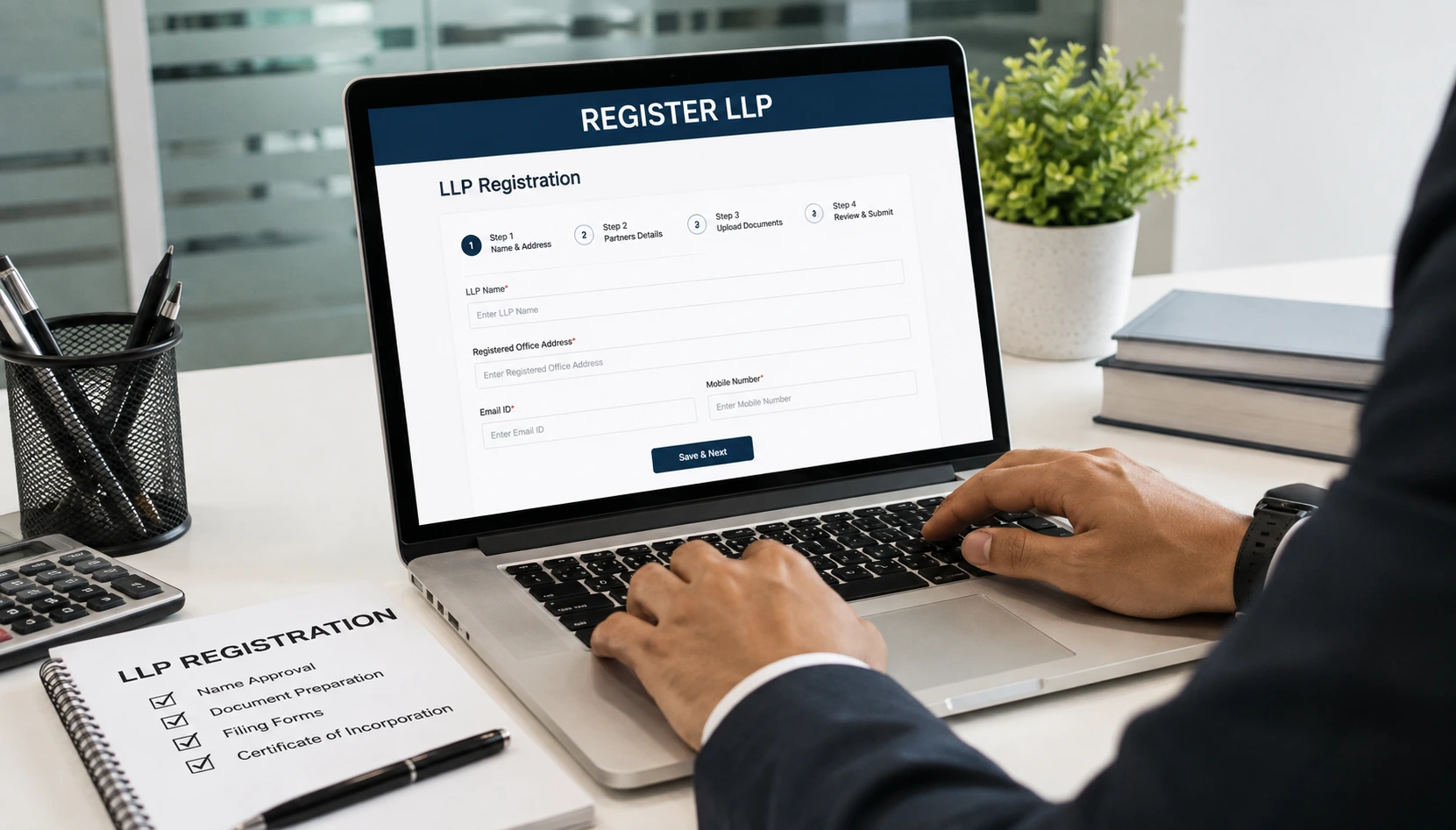
Step-by-Step LLP Registration Process in Pune
The incorporation process is completed through the Ministry of Corporate Affairs (MCA) system. The following steps provide a practical overview.
Step 1: Decide the Business Structure
Before submitting an application, discuss whether an LLP is appropriate for your business.
Consider:
- Number of partners
- Investment requirements
- Liability protection
- Expected turnover
- Future funding requirements
- Compliance expectations
- Long-term expansion plans
For businesses expecting substantial external investment, a company structure may sometimes be more suitable.
Step 2: Obtain Digital Signature Certificates
The designated partners generally need Digital Signature Certificates (DSCs) for digitally signing incorporation documents.
The DSC is used to authenticate electronic documents submitted through the MCA system.
Ensuring that the details on the identity documents and application forms match can help prevent avoidable delays.
Step 3: Obtain or Apply for DIN/DPIN
Designated Partner Identification Number (DPIN) is used to identify designated partners.
The applicable identification requirements are handled as part of the incorporation process where permitted.
Accurate personal information is important because discrepancies in names, dates of birth, or identity documents may lead to additional requirements.
Step 4: Select a Unique LLP Name
Choosing the right business name is an important part of incorporation.
The proposed name should:
- Be distinctive
- Follow applicable naming rules
- Not infringe existing trademarks
- Avoid prohibited or restricted expressions
- Reflect the nature of the proposed business
It is advisable to check name and trademark availability before finalizing the name.
Step 5: Apply for Name Reservation
The proposed LLP name can be submitted through the applicable MCA process for name reservation.
If the name is accepted, you can proceed with incorporation within the prescribed period.
If the proposed name is rejected, alternatives may need to be submitted.
Step 6: Prepare Incorporation Documents
Once the name-related requirements are addressed, the incorporation application and supporting documents must be prepared.
Information generally includes:
- Proposed LLP name
- Registered office details
- Partner information
- Designated partner details
- Business activities
- Contribution details
- Contact information
All information should be carefully checked before submission.
Step 7: Submit the Incorporation Application
The incorporation application is submitted electronically through the MCA portal along with the applicable documents and fees.
The Registrar of Companies examines the application and supporting information.
If clarification or additional information is requested, it should be provided within the prescribed timeline.
Step 8: Receive the Certificate of Incorporation
Once the application is approved, the LLP receives its Certificate of Incorporation.
The certificate confirms that the LLP has been legally incorporated.
After incorporation, the business can proceed with activities such as opening a current account, obtaining applicable registrations, and entering into business contracts.
Step 9: Execute the LLP Agreement
The LLP Agreement is one of the most important documents for the business.
It establishes the relationship between the partners and generally covers matters such as:
- Capital contribution
- Profit-sharing ratio
- Partner responsibilities
- Decision-making powers
- Admission of new partners
- Retirement or resignation
- Dispute resolution
- Withdrawal arrangements
- Business management
The agreement should be properly drafted according to the specific requirements of the partners.
Step 10: Complete Applicable Post-Incorporation Registrations
Depending on the nature of your business, you may need additional registrations such as:
- GST registration
- Professional Tax registration
- Shops and Establishments registration
- Import Export Code
- MSME/Udyam registration
- Trademark registration
- Other industry-specific licenses
Not every LLP needs every registration. Requirements depend on the business activity, turnover, location, and applicable laws.
Documents Required for LLP Registration
The exact documentation can vary depending on the partners and registered office arrangement.
Documents generally required from partners include:
- PAN card
- Identity proof
- Address proof
- Passport-size photograph
- Mobile number
- Email address
- Digital Signature Certificate
Registered office documents may include:
- Ownership proof or rent/lease agreement
- Utility bill
- No-objection certificate from the property owner, where applicable
- Other address-related documents as required
Documents should be current, legible, and consistent with the information entered in the incorporation application.
How Much Does LLP Registration Cost?
The total cost depends on several factors, including:
- Government filing fees
- Contribution amount
- Stamp duty
- DSC charges
- Professional fees
- Drafting requirements
Therefore, there is no single fixed cost applicable to every LLP.
Entrepreneurs should request a transparent cost estimate before starting the process.
How Long Does LLP Registration Take?
The registration timeline depends on:
- Name approval
- Accuracy of submitted documents
- Government processing
- Whether additional clarification is requested
- Timely response to MCA queries
A straightforward application with accurate documentation can generally be completed faster than an application requiring repeated corrections.
LLP Registration in Pune: Why Professional Assistance Can Help
Entrepreneurs looking for LLP registration in Pune often prefer professional guidance because the incorporation process involves documentation, MCA forms, naming requirements, and post-registration compliance.
Professional assistance can help with:
- Selecting an appropriate business structure
- Preparing documentation
- Name selection
- MCA filing
- LLP Agreement drafting
- Post-incorporation registrations
- Compliance guidance
This can reduce administrative work and help entrepreneurs concentrate on building their businesses.
What Are LLP Registration Services?
Professional LLP registration services in Pune may cover the complete incorporation journey instead of only submitting the initial application.
Depending on the provider, services can include:
- Consultation
- Document verification
- DSC assistance
- Name reservation
- Incorporation filing
- LLP Agreement assistance
- PAN/TAN-related support
- Post-registration compliance guidance
Before selecting a provider, clarify exactly what is included in the package.
LLP vs Private Limited Company
An LLP and private limited company are separate legal structures with different characteristics.
| Factor | LLP | Private Limited Company |
|---|---|---|
| Minimum members | Generally 2 partners | Generally 2 members |
| Liability | Limited | Limited |
| Management | Partner-based | Director-based |
| Compliance | Generally flexible | Generally more structured |
| External investment | More limited | Generally more suitable |
| Suitable for | Professional/service businesses | Scalable startups and investment-led businesses |
Entrepreneurs considering Private limited company registration in Pune should compare their funding plans, ownership structure, compliance requirements, and growth objectives before making a decision.
Choosing the Right LLP Registration Consultant
Selecting the right professional can make the registration experience considerably easier.
Look for a provider that offers:
- Transparent pricing
- Clear documentation requirements
- Experience with MCA procedures
- Agreement drafting support
- Post-registration assistance
- Responsive communication
If you are comparing Top Llp Registration Services in Pune, do not evaluate providers solely on price. Consider the quality and scope of support included.
Similarly, businesses searching for Best llp registration services in pune should check whether the consultant provides assistance beyond incorporation.
Why Choose Azalea Advisors?
Azalea Advisors helps entrepreneurs understand business registration requirements and complete necessary documentation and compliance processes.
Professional assistance can be particularly valuable for first-time entrepreneurs who are unfamiliar with MCA procedures.
The right consultant can help you understand:
- Which business structure fits your objectives
- Which documents are required
- How the incorporation process works
- What compliance follows registration
- Which additional registrations may apply
Common Mistakes to Avoid During LLP Registration
Several avoidable mistakes can delay incorporation.
1. Choosing a Name Without Checking Availability
A proposed name may conflict with an existing company, LLP, or trademark.
2. Submitting Mismatched Documents
Differences in names, addresses, or other personal information can create verification issues.
3. Using Incomplete Registered Office Documents
Ensure that the registered office documentation meets the applicable requirements.
4. Ignoring the LLP Agreement
A poorly drafted agreement can create disputes between partners later.
5. Focusing Only on Incorporation
Registration is only the beginning. Annual filings, accounting, tax compliance, and other obligations must also be managed.
Compliance After LLP Registration
An LLP must meet applicable annual and event-based compliance requirements.
Depending on the circumstances, this may include:
- Annual returns
- Statement of Account and Solvency
- Income tax return
- Maintenance of books and records
- Event-based filings
- Changes in partners or registered office
- Applicable GST filings
Failure to meet statutory requirements can result in additional fees, penalties, or other consequences.
Therefore, compliance should be planned from the beginning rather than handled only when a deadline approaches.
Is LLP Suitable for Your Business?
An LLP may be a good option if:
- You have two or more business partners
- You want limited liability protection
- You prefer flexible management
- Your business does not depend heavily on external equity funding
- You operate a professional or service-oriented business
A different structure may be preferable if your primary objective is venture capital funding, large-scale equity investment, or rapid corporate expansion.
Frequently Asked Questions About LLP Registration
Q1. Can two people register an LLP?
Yes. An LLP generally requires at least two designated partners, subject to the requirements of applicable law.
Q2. Is there any minimum capital required for an LLP?
There is generally no prescribed minimum capital requirement. Partners can contribute capital according to the agreed business arrangement and applicable requirements.
Q3. Can an LLP be registered from a residential address?
A residential property can potentially be used as an LLP’s registered office if the applicable documentation and consent requirements are satisfied.
Q4. How is an LLP different from a partnership firm?
An LLP is a separate legal entity and generally provides limited liability protection to its partners, whereas a traditional partnership has a different legal and liability framework.
Q5. Does an LLP need GST registration?
GST registration depends on factors such as turnover, business activity, interstate supplies, and other statutory conditions. It is not automatically mandatory for every LLP.
Q6. Does an LLP need annual compliance?
Yes. LLPs have statutory annual filing and other compliance requirements. The exact obligations depend on the LLP’s circumstances.
Q7. Can an LLP be converted into a private limited company?
Certain LLPs may be eligible for conversion into a company subject to the applicable legal provisions and procedural requirements.
Q8. Is an LLP suitable for startups?
It can be suitable for startups that prioritize operational flexibility and limited liability. However, startups planning significant equity investment should carefully compare an LLP with a private limited company.
Conversion-Focused CTA
Choosing the right business structure can influence your liability, compliance, taxation, funding opportunities, and long-term growth.
If you’re planning to establish an LLP in Pune, Azalea Advisors can help simplify the registration process with professional guidance from documentation through incorporation and compliance support.
Ready to register your LLP?
Contact Azalea Advisors today to discuss your business requirements, understand the applicable registration process, and take the next step toward establishing your business with confidence.